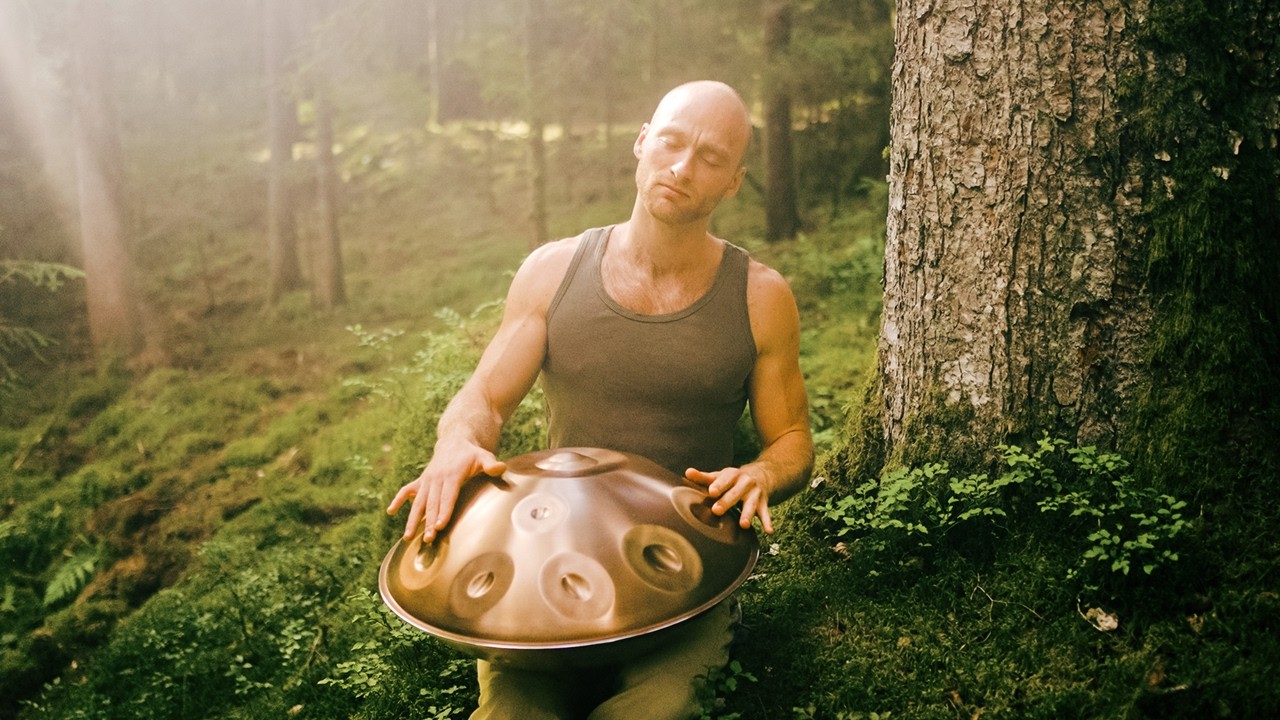
We live in a culture of perpetual striving—always reaching for the next milestone, the next achievement, the next version of ourselves that will finally feel at ease. A better job, more money, a nicer home. The narrative never stops: once you arrive, the next goal materializes on the horizon. There's nothing inherently wrong with ambition. Growth and improvement are natural human drives. But somewhere along the way, a quieter question deserves attention: what are we trading away in pursuit of what's ahead? Our health. Our time. Our presence with the people who matter. The small, ordinary moments that, when you look back, turn out to have been the actual substance of a lived life.
This is the philosophical doorway through which Malte Marten's extended handpan composition opens. Calm Nervous System (1111 Hz) is a meditation on that trade-off—not as a guilt trip, but as an invitation to reclaim something being quietly surrendered. At its core is a simple, almost radical proposition: a better life doesn't require abandoning the one you're already in.
What Is the Handpan and Why Does It Matter?
The handpan is a relatively young instrument—born in the early 2000s in Bern, Switzerland, evolving from the steelpan tradition but refined into something uniquely its own. It consists of a dome-shaped metal vessel, typically made from hardened steel, with a central note (the ding) and surrounding tone fields (the notes) that are struck with bare hands. The sound is immediate, warm, and deeply resonant—there's no amplification needed, no mediation between player and listener. What emerges is almost vocal in its expressiveness.
This intimacy is crucial to understanding why the handpan has become a primary instrument for nervous-system regulation and meditative practice. Unlike electronic instruments, which can feel distancing, or acoustic instruments that require years of technique to sound refined, the handpan invites players and listeners into a space of genuine presence. Strike a tone field, and you're engaging directly with physics, with air, with the body's own frequency response.
How Does Frequency Healing Through Sound Work?
The 1111 Hz frequency referenced in Marten's piece sits at the intersection of music theory and bioacoustic science—though it's worth noting that the claims around specific frequencies are still contested in rigorous research. What is well-documented is that certain musical frequencies, particularly those in the lower ranges, can activate the parasympathetic nervous system, the body's natural brake on stress and arousal. Sustained tones, especially when delivered through harmonic instruments like the handpan, tend to slow heart rate variability and deepen breathing patterns. The listener doesn't have to do anything; the sound does much of the work.
A D Aegean tuning (the scale Marten uses here, as indicated in his instrument note) creates a modal, minor-key framework that avoids the tension of leading tones and unresolved harmonic motion. The effect is gravitational—the music pulls you downward, into the body, away from the mental chatter that typically dominates waking consciousness. There's no dramatic arc, no climax to anticipate. Instead, there's a kind of permission to simply be.
Why the Resistance to Presence?
One of the unspoken costs of achievement culture is the erosion of what might be called the "useless moment." The hour spent with no productivity metric. The conversation that leads nowhere tangible. The walk that has no destination. Modern life actively trains us out of these experiences. The phone in your pocket offers infinite stimulation; your calendar promises that every block of time should serve some future outcome. Being present becomes a luxury, something you earn after you've succeeded enough.
But the paradox is this: the moments most people describe as having shaped their lives—not the big victories, but the small ones—are almost always moments that felt purposeless at the time. A conversation. A meal. Watching light move across a room. Music that asked nothing of you except to listen.
Making Room for Aliveness
Marten's central prescription in the piece's description is deceptively simple: "Make room for something every day that has no purpose other than making you feel alive." This isn't a call to abandon responsibility or ambition. It's a recognition that aliveness—the felt sense of being present in your own body and in the world around you—is not a reward you unlock after achieving enough. It's available now. It's the handpan, sustained for an hour, with no other ask.
This is where the music functions as a kind of technology. Not in the digital sense, but in the older, deeper sense—a tool deliberately designed to facilitate a specific human state. In this case, the state is nervous-system calm: the body's rest-and-digest mode, the mind's natural tendency toward presence when it's not in survival-response or goal-pursuit mode. The handpan becomes a tuning fork. You listen, and your nervous system listens back, gradually settling into alignment with the frequencies being offered.
The Instrument as Teacher
Marten's own background is telling. He's not just a performer but someone committed to teaching the handpan through structured method—his Handpan Fundamentals and the broader Malte Marten Method suggest someone who sees the instrument as having pedagogical value beyond entertainment. Learning to play the handpan, or even just learning to listen to it with genuine attention, becomes a practice in presence. The fingers find the tone fields by feel, not sight. The ear develops sensitivity to the subtle variations in timbre. The body slows down to match the instrument's natural tempo.
For listeners, the one-hour format serves a similar function. It's long enough that the ordinary mental noise—the to-do list, the email you forgot to send, the conversation replaying in your head—begins to settle. By the midpoint, something has shifted. The mind stops scanning for what's next and simply absorbs what's here.
Where to Go From Here
If this piece resonates, the invitation is to approach it not as background music but as dedicated practice. Set aside time—even 20 or 30 minutes—to listen without the phone, without the secondary stimulation that has become the default. Notice what happens in your body. Does your breathing slow? Do your shoulders drop? What thoughts arise in the space when you stop pushing toward something? These aren't mystical questions; they're simply empirical observations about your own nervous system's response to sustained, harmonic sound. From there, you might explore live handpan music in your area, learn to play the instrument yourself, or simply make this weekly listening a non-negotiable part of your week—the thing that has no purpose except to remind you that you're alive.